
A study led by Susana Araujo, who recently earned her doctorate from the Institute for Theoretical and Experimental Astronomy (IATE), has successfully detected hundreds of giant pulses from a magnetar, one of the most exotic and violent objects in the cosmos. The discovery, made using the radio telescopes of the Argentine Institute of Radio Astronomy (IAR), represents a significant advancement in Argentina's capability to study transient phenomena.
By Facundo Rodriguez
facundo.rodriguez@unc.edu.ar
Neutron stars are, in themselves, extreme objects: ultra-dense remnants left behind after the explosion of a massive star. But there exists an even more enigmatic subclass: magnetars. As their name suggests, they possess magnetic fields billions of times stronger than any earthly magnet. They are so powerful that they can deform matter and trigger explosions of X-rays and gamma rays.
Although about thirty are known in our galaxy, only six magnetars have been detected at radio frequencies. Among them, XTE J1810-197 stands out, located about ten thousand light-years away, in the constellation Sagittarius. This recent study constitutes the first analysis of individual pulses from a magnetar carried out entirely with national infrastructure.
"We used an Argentine instrument, operated at a CONICET institute, with observations carried out by local personnel and analysed completely within the country," Araujo summarises. "And we are contributing to understanding an object that is currently at the forefront of radio astronomy research."
What are these pulses, and why do they matter?
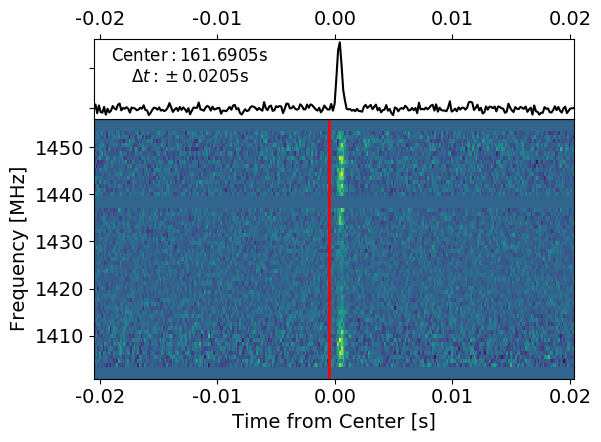
Magnetars do not emit radio waves continuously; rather, they do so in brief bursts, sometimes separated by years of silence. To study them, analysing the average signal is not enough: it is key to identify individual events, isolated pulses that can be thousands of times brighter than the background level. These outbursts are known as giant pulses. pulsos gigantes.
Between September 2022 and July 2023, Araujo and her team used the IAR's two 30-meter antennas, located in Pereyra Iraola Park (Buenos Aires province), to observe XTE J1810-197 almost daily. They accumulated over 260 hours of observation and detected 249 giant pulses, some with record-breaking energies for this object.
"We recorded the most intense events reported for this magnetar up to the time of the paper's submission," the researcher notes. One of the pulses reached a brightness comparable to that of certain high-intensity fast radio bursts, the most energetic radio phenomena in the universe.
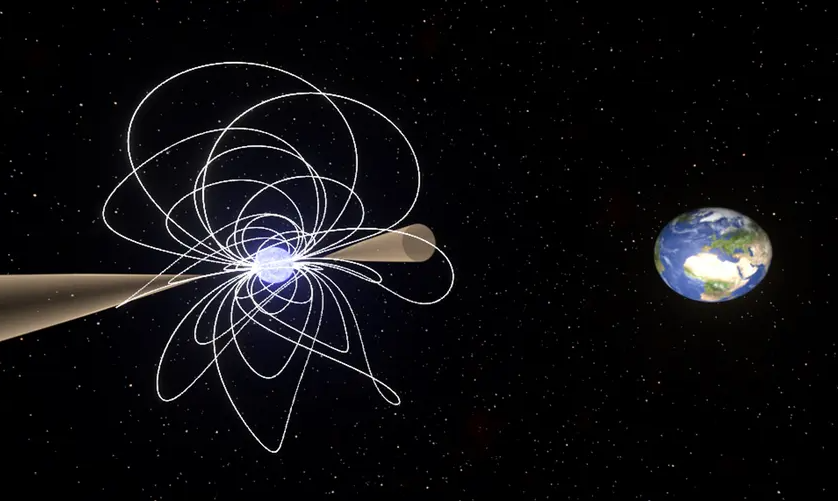
Artistic representation of the magnetar under study. The emission is believed to be generated in a confined region around the star, indicated here by the orange cones. Credits: © Gregory Desvignes / MPIfR.
The advantage of being on the right side of the planet
One of the key factors in the work was strategic: geographic location. While most major radio telescopes are located in the northern hemisphere, the IAR is in the south. And in astronomy, that can make all the difference.
"IAR is geographically complementary to other radio telescopes," Araujo explains. "In the study of variable phenomena, continuous coverage is essential, but no telescope can achieve it on its own. By observing during intervals that others did not cover, we were able to capture the magnetar's peak activity period."
In fact, in January and February 2023, when the pulse rate per hour reached its peak, the Green Bank Telescope, one of the world's most sensitive, was not observing the source. The IAR was the sole witness to that period of maximum activity.
The science behind the noise
Detecting these pulses was not straightforward. Radio observations are plagued by interference: signals from phones, satellites, and even solar emissions. Moreover, the technique for searching for individual pulses was new to the group.
"No one really knew how to implement it," Araujo recalls. "I had to reconstruct it from papers, validate it with other sources, and convince myself that the results were correct. It was a difficult process, but very rewarding."
The outcome is not just a scientific publication, but also a methodology now available to the community. "I made sure that my doctoral thesis documented every step in detail. In practice, it works as a guide for applying this technique with the IAR antennas," she explains.
What do these pulses tell us about the universe?
Giant pulses are not just spectacular phenomena; they contain key information. Through the dispersion of radio waves (caused by free electrons in interstellar space), it is possible to estimate distances and study the medium through which the signal travels.
Furthermore, their extremely high brightness temperatures, millions of times higher than the surface of the Sun, indicate that the radiation is of coherent origin, a physical mechanism that is not yet fully understood.
"Radio emission from neutron stars has been an open problem for over 50 years," Araujo points out. "And magnetars, with their extreme magnetic fields, push us to the limits of our understanding of physics."
The closing of one chapter and the start of another
For Susana Araujo, this work marks the culmination of her doctorate. "It was an intense process, both demanding and liberating. I learned a tremendous amount. Today, in my group, they consider me Argentina's magnetar expert, although I feel there is still so much to learn. But having achieved a positive detection is immensely satisfying."
Having recently completed her PhD, Susana received a fellowship from the Alexander von Humboldt Foundation to pursue postdoctoral research at the Max Planck Institute for Radio Astronomy (Bonn, Germany), where she will continue studying these objects.
This work not only positions the IAR as an observatory capable of contributing to the study of transient phenomena but also highlights the value of local scientific infrastructure and the training of new generations of researchers.
"The most important thing is being able to access a radio telescope of our own for the necessary time and to design long-term campaigns. That is very difficult when you depend on foreign facilities," Araujo concludes.
At the frontiers of physics, where extreme magnetic fields and fleeting explosions dominate, Argentine astronomy is beginning to establish an increasingly firm presence.
Scientific publication |
| Giant pulses from the magnetar XTE J1810-197 observed with the IAR radio telescopes
Team | S. B. Araujo Furlan (IATE, CONICET-UNC, Argentina), G. E. Romero (IAR, CONICET-CICPBA-UNLP; UNLP), E. Zubieta (IAR, CONICET-CICPBA-UNLP; UNLP), G. Gancio (IAR, CONICET-CICPBA-UNLP; UNLP), F. García (IAR, CONICET-CICPBA-UNLP; UNLP), S. del Palacio (Chalmers University of Technology, Suecia) y C. O. Lousto (Rochester Institute of Technology, EE.UU.). |