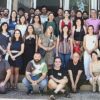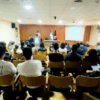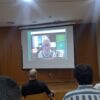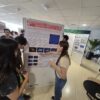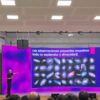
Between December 9 and 12, 2025, the city of Córdoba was the setting for the international scientific meeting “From Decoupling to Galaxies and the Large-scale structure (DGL Fest)”, an event organized in honor of the distinguished career of Diego García Lambas. The meeting, organized by the Institute of Theoretical and Experimental Astronomy (IATE, CONICET-UNC), took place in person at the CONICET-IMBIV Auditorium of the Faculty of Exact, Physical, and Natural Sciences of the National University of Córdoba and was endorsed by the Córdoba Astronomical Observatory (OAC).
Participation and Organizing Committees
The “DGL Fest” successfully brought together a broad and prestigious astronomical community, evidencing the deep respect and international recognition of Dr. García Lambas’s career. According to the official list, it gathered more than 90 participants, representing an international diversity that included institutions from Argentina, Brazil, Chile, the United States, Canada, Germany, Mexico, Spain, and France.
The event brought together a prominent selection of leading figures in the field of Astronomy, whose guest list included: Jailson Alcaniz (Observatório Nacional, Brazil), Victoria Alonso (OAC, IATE – Argentina), Vladimir Avila-Reese (UNAM – Mexico), Georgina Coldwell (UNSJ, CONICET – Argentina), Mario Diaz (UTRGV – USA), Júlio Fabris (Espirito Santo U. – Brazil), Gaspar Galaz (UC – Chile), Leopoldo Infante (Carnegie Science, Las Campanas Obs. – Chile), Susana Landau (UBA, CONICET – Argentina), Lucas Macri (UTRGV – USA), Julio Navarro (U. Victoria – Canada), the 2019 Nobel Prize in Physics, James Peebles (Princeton – USA, remote participation), Pablo Recabarren (UNC, CONICET – Argentina), Ariel Sánchez (MPE – Germany), and Claudia Scoccola (Department of Physics, FCFM, University of Chile).
The scientific organization was carried out by a committee of colleagues and professionals from his academic circle: Sol Alonso, Saulo Carneiro, Sofía Cora, Hernán Muriel, Oscar Reula, Ariel Sánchez, and Patricia Tissera. Local logistics were managed by the IATE Local Organizing Committee (LOC), composed of: Carlos Bornancini, Patricio Colazo, Octavio García, Sebastián Gualpa, Heliana Luparello, Ana O’Mill, Nelson Padilla, Dante Paz, Facundo Rodríguez, Silvio Rodríguez, and Facundo Toscano.
A Scientific Program Covering the Great Questions of the Cosmos
Over the course of four days, the meeting offered an exhaustive and diverse scientific program, structured into invited talk sessions, oral presentations, and poster sessions.
The central themes reflected the broad research lines cultivated by García Lambas throughout his career:
-
Cosmology and Fundamental Physics: Advances in gravity theories, such as unimodular gravity, were presented and debated; modern cosmological tensions like the “Hubble Tension” were analyzed; and models of dark energy and viscous dark matter were explored in light of new observational data.
-
La Radiación Cósmica de Fondo y el Universo Primordial: Varias sesiones se dedicaron al estudio de la Radiación Cósmica de Fondo (CMB), incluyendo el análisis de sus anisotropías, polarización y la investigación de anomalías como el “Cold Spot”, tema de reciente interés en el trabajo del homenajeado.
-
Galaxy and Halo Formation, Evolution, and Connection: This central pillar of the meeting covered the galaxy-halo connection, galaxy bias, alignments, and the effects of the cosmic environment (clusters, filaments, and voids) on galaxy properties. Results from state-of-the-art simulations and semi-empirical models were presented.
-
New Observational Windows and Relativistic Astrophysics: The program included talks on gravitational wave astronomy, celebrating its first decade of discoveries, and on the astrophysics of cosmic rays and active galactic nuclei.
Tribute to a Career of Scientific and Institutional Leadership
This scientific meeting was, in essence, a well-deserved recognition of the vast and fruitful career of Dr. Diego García Lambas. With more than 440 scientific publications exceeding 10,000 citations, his seminal work on the large-scale structure of the universe has influenced generations.
His legacy transcends academic production. As a mentor, he has supervised multiple postgraduate theses and undergraduate works. His vision and institutional leadership were key in the revitalization of the Bosque Alegre Astrophysical Observatory, the creation of the Macón Astronomical Center (Salta), and the promotion of new sites such as Susques (Jujuy). Furthermore, he was a fundamental pillar in the development of the Astronomy degree at the National University of San Juan and led international projects such as the TOROS observatory, dedicated to the search for optical counterparts of gravitational waves.
For these contributions, he has received distinctions such as the Enrique Gaviola Award from the National Academy of Sciences, the José Luis Sérsic Award from the Argentine Astronomical Association, and the Honorary Mention for Scientific Merit from the National Senate, and he is also a Member of the National Academy of Sciences of Argentina.
A Legacy That Inspires the Future
The "DGL Fest" was not only a look back to celebrate achievements but also an active forum to discuss the future of Cosmology and Astrophysics. Technical discussions were oriented toward the challenges of the next decade, paving the way for the scientific exploitation of large astronomical surveys and next-generation space missions.
This meeting decisively reinforced the international collaboration ties of Argentine astronomy and made it clear that the most enduring legacy of a researcher is built through scientific excellence, the mentoring of new generations, and the strategic development of institutions that stand the test of time.
Links of interest:
-
Official event website: https://dgl-fest.iate.conicet.unc.edu.ar/
-
Scientific program: https://dgl-fest.iate.conicet.unc.edu.ar/2025/09/29/program-2/